INT8 Adapter
74.7% ↓
Smaller adapter file
FP32 2.006 MiB → INT8 0.507 MiB. Adapter file only; the CLIP backbone is excluded.
View quantization results ↗Selected project / 001 · Computer vision
As the first author of SurgClip, I investigate how general-purpose vision–language representations adapt to surgical video. My work connects keyframe–phase indexing, lightweight adapter training, retrieval evaluation and visualization. INT8 quantization and PQ compression experiments examine trade-offs in matching quality, storage and runtime.
+33.78pp
Full-index evaluation · includes training data
Accuracy change after phase adaptation
184,578 frames · 7 candidate phase texts
Current full-index evaluation, including frames used in training.Evaluation context ↓
01 / Overview
Surgical video × Vision–language
SurgClip investigates how lightweight domain adaptation improves matching between surgical keyframes and phase descriptions, examining the adaptability of general-purpose vision–language models within a clearly defined evaluation scope.
Surgical phases share instruments, anatomy and actions, making subtle visual distinctions difficult to match with text. SurgClip trains a lightweight phase adapter on CLIP features, using the baseline model to test whether domain information improves alignment between keyframes and phase descriptions.
My work spans video frame extraction, annotation indexing, adapter training, retrieval evaluation and visualization. Separate comparisons of domain adaptation, INT8 quantization and PQ embedding compression measure matching quality, adapter file size, embedding storage and runtime costs, tying each conclusion to its experimental setting.
Compare keyframe–text rankings from baseline and phase-adapted CLIP, using aggregate metrics and phase-level results to assess adaptation within the stated evaluation scope.
Examine adapter file size, embedding storage, matching quality and latency separately, rather than assuming a smaller model file makes the system faster.
02 / Approach
From video data to measurable retrieval results
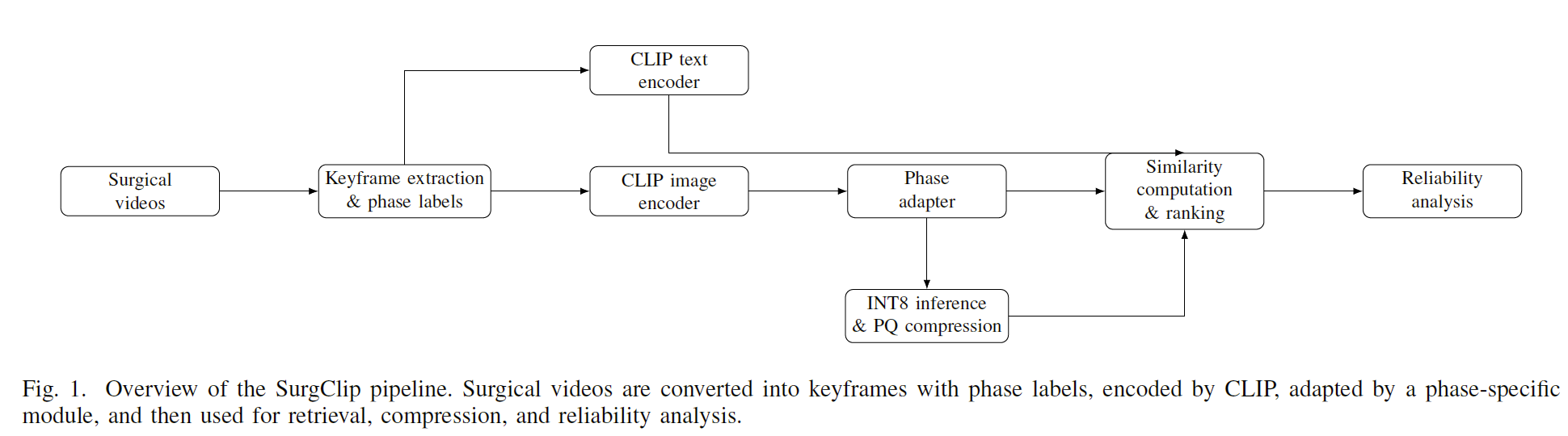
Extract frames from Cholec80 videos and associate them with phase annotations, organizing an index for training, feature extraction and evaluation to provide a consistent data basis for model comparisons.
Train a lightweight phase adapter on image and text encoder features, then use normalized representations and cosine similarity for matching. Compare the resulting rankings with baseline CLIP to assess the effect of domain adaptation.
Compare Top-1 / Top-5 accuracy and phase-level performance, using examples and visualization to interpret the results. Evaluate INT8 adapters and PQ feature compression separately, recording matching quality, storage and runtime costs.
03 / Experiments
Accuracy, storage and runtime
In the 184,578-frame full-index evaluation, which includes training data, phase adaptation raised Top-1 from 17.77% to 51.55% and Top-5 from 83.96% to 96.18%.
These are full-index results recorded in the repository. Each frame is matched against seven candidate phase texts. Top-1 and Top-5 indicate whether the correct phase appears in the first one or five results.
| Model | Top-1 | Top-5 |
|---|---|---|
| Baseline CLIP | 17.77% | 83.96% |
| Phase-Adapted CLIP | 51.55% | 96.18% |
| Adapted CLIP · INT8 | 51.03% | 95.75% |
Sources:Overall evaluation / INT8 evaluation
INT8 Adapter
74.7% ↓
FP32 2.006 MiB → INT8 0.507 MiB. Adapter file only; the CLIP backbone is excluded.
View quantization results ↗Product Quantization
≈150×
180.252 MiB → 1.204 MiB, estimated from codes and codebooks for 92,289 vectors.
View PQ results ↗In the recorded CPU benchmark, adapter-only latency increases from 0.0474 ms in FP32 to 0.1605 ms in INT8. This experiment demonstrates a trade-off between file size and runtime cost.
The repository already records preliminary brightness-and-blur shift results. Next, evaluate on a video-disjoint test set, standardize evaluation and timing protocols, and reassess stability on a consistent sample and model pipeline.
04 / Publication
Paper, code and experiment records
CSCWD 2026
29th International Conference on Computer Supported Cooperative Work in Design · 2026 · pp. 1739–1744
@inproceedings{cao2026surgclip,
  author = {Yueran Cao and Jier Zhang and Junheng Fang
            and Yushan Pan and Nan Xiang},
  title = {SurgClip: Accelerated Domain-Adaptive CLIP
           for Surgical Keyframe-Text Retrieval},
  booktitle = {Proceedings of the 29th International
               Conference on Computer Supported
               Cooperative Work in Design (CSCWD)},
  year = {2026},
  pages = {1739--1744},
  url = {https://ieeexplore.ieee.org/document/11582803}
}
Publication details follow the project README; results come from its public experiment records. This is an academic research project. Use of Cholec80 data is subject to the dataset terms.Source material ↗